250W Smart Battery Charger (24V–72V) for E-Bike, Scooter & Industrial Equipment | OEM Manufacturer
A 250W Smart Battery Charger (24V–72V) for E-Bike, Scooter & Industrial Equipment is built to solve a common buyer problem: getting a reliable, compact charging solution that can match different battery-powered platforms without adding unnecessary complexity. In practical terms, buyers need a charger that can fit the device, connect cleanly, show charging status, and integrate into an OEM or replacement program. A unit in this category typically combines an enclosed AC/DC power stage, visible status indicators, and a cable/connector configuration that supports different equipment interfaces.
Because the provided product information is limited to visible features and general form, this page focuses on what can be evaluated safely: housing style, connector variety, charging indicator design, and the kinds of applications this product family usually serves. If you are sourcing for e-bikes, scooters, battery packs, or industrial devices, the real value is not just wattage. It is whether the charger is easy to specify, consistent to assemble, and practical for your end user or service team.
Product Overview
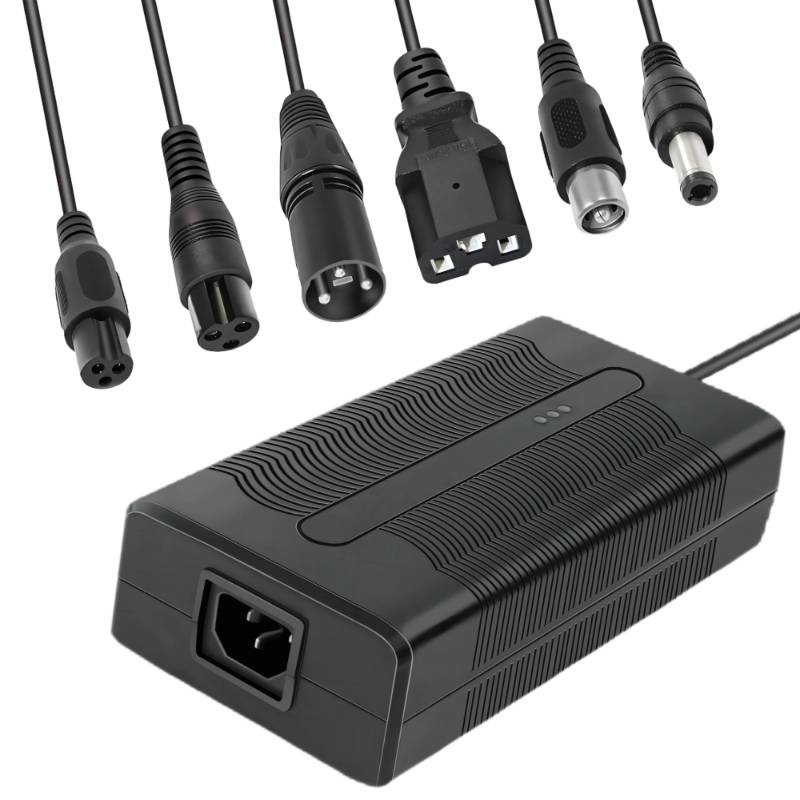
This product category appears to be a compact enclosed power adapter or charger with a black rectangular housing, molded side textures, and onboard indicator LEDs. The visible IEC-style AC inlet suggests a mains-powered design. In the supplied images and notes, several interchangeable output plug types are also shown, which indicates a universal or multi-application charging setup rather than a single fixed connector design.
For OEM buyers, that matters. A charger that supports multiple connector styles can reduce platform fragmentation, simplify service parts management, and help accommodate different regional or device-level requirements. For industrial equipment, a robust external charger can also make battery maintenance easier because the power electronics remain outside the device enclosure.
Visible Features and Product Structure
Enclosed rectangular housing
The visible housing is a matte black, low-profile rectangle with rounded edges. The side surfaces show ribbed or wave-textured molding. This kind of surface treatment is commonly used to improve grip, reduce visual scuffing, and support heat dissipation through enclosure design, although the exact thermal performance is not stated.
Status indicator lights
Three small indicator LEDs are visible on the top/front area. In charger products, LED indicators are commonly used to show standby, charging, or full-charge states. The exact meaning of each light pattern is not supplied, so it should be confirmed against the final electrical specification or user manual.
Input and output connection style
The supplied data references a visible IEC-style AC inlet on one version and an attached fixed cable on another view. Multiple output connector variants are also shown, including barrel-style DC connectors and other round 2- and 3-pin plugs. This suggests a product family that can be configured for different loads, though the exact pinout, polarity, and voltage are unknown and should not be assumed.
Key Capabilities Buyers Usually Look For
When sourcing a charger in the 250W class, buyers typically compare a few practical points rather than only the nameplate rating. These include charging compatibility, connector stability, enclosure durability, and serviceability. A smart charger for 24V–72V battery systems is often chosen because it can support a broad range of powered equipment, from small mobility products to industrial batteries used in carts, tools, or portable machines.
From an integration standpoint, the value is in how the charger fits the system. A compact block-style adapter can be easier to package near a wall outlet, on a maintenance bench, or in a spare-parts kit. A multi-connector approach also helps distributors and OEM teams support more than one product line with fewer SKUs.
Materials and Finish Options
The visible product appears to use an injection-molded plastic or polymer enclosure with a matte black finish. That is a standard choice for external power electronics because it is cost-effective, lightweight, and easy to shape into a durable shell with cable exits, vents, and indicator windows.
For OEM programs, finish options may include different housing colors, logo marking, label layouts, and texture adjustments. The supplied data does not specify alternative materials or coatings, so any customization should be treated as project-dependent. If your application requires a more rugged enclosure, ask whether reinforced plastic, different cable strain relief, or connector overmolding can be supported.
Manufacturing and Assembly Considerations
Based on the visible construction, this product likely falls into a manufacturing path that combines electronics assembly with molded housing production. The enclosure appears suitable for injection molding, while the internal circuit would typically be assembled as a power conversion module. Cable termination, connector overmolding, LED placement, and final enclosure closure are all relevant to the finished unit.
For buyers, the most important manufacturing questions are usually consistency and repeatability. If the charger is intended for OEM use, confirm that the same housing, cable type, and connector format can be built across multiple order runs. Also verify whether the unit can be labeled for your brand, as that often matters for retail packaging, service identification, and after-sales support.
Application Scenarios
This type of charger or power adapter is relevant wherever a compact external power source is needed. Common use cases may include:
E-bike battery charging stations
Scooter fleet maintenance and replacement charging
Portable industrial equipment with removable battery packs
Small devices that use an external low-voltage adapter
Workshop bench power for compatible electronics
Spare charger programs for distributors and service centers
Because the provided information does not confirm a specific device match, compatibility should always be checked against voltage, connector type, polarity, and battery management requirements before purchase.
Quality Control and Buyer Checks
For this kind of product, quality control is usually judged through a mix of visual inspection, electrical verification, connector fit, and functional testing. Since the supplied data does not include formal test results or certifications, buyers should request the documentation needed for their market and application.
Useful buyer checks include:
Confirming the actual output voltage and current rating
Checking whether the connector style matches the battery or device port
Verifying LED behavior and charge-status logic
Inspecting cable strain relief and housing fit
Reviewing safety documentation and compliance requirements for your destination market
If the charger will be used in industrial or fleet service environments, repeatability matters as much as initial performance. A stable charger platform reduces returns and avoids confusion between similar-looking power supplies.
Customization Guidance for OEM and Distribution Projects
If you are buying for a private label or OEM project, define the configuration before asking for samples. The most useful details are the target battery voltage range, connector type, cable length, labeling needs, and expected operating environment. The product data suggests a flexible platform, but flexibility only helps if the final build matches your actual system.
Customization may involve housing color, logo printing, indicator labeling, connector termination, and packaging. Some projects also require different output leads for regional markets or device families. Because the exact electrical specifications are not listed here, avoid locking in a design until the charger has been checked against your battery chemistry and charging profile.
How to Decide Whether This Charger Fits Your Project
Start with the battery, not the charger. Match the charger to the nominal battery voltage and the approved charging method. Then review the connector interface, enclosure size, and expected user environment. For consumer mobility products, convenience and compactness may matter most. For industrial equipment, serviceability and connector reliability usually carry more weight.
Also consider how the product will be used in the field. If end users need to swap charger ends, a multi-connector kit can be helpful. If the charger will remain fixed in a machine or cabinet, a hardwired cable may be preferable. The right choice depends on your maintenance process and the level of standardization in your product line.
Request OEM Support
If you are sourcing a 250W Smart Battery Charger (24V–72V) for E-Bike, Scooter & Industrial Equipment | OEM Manufacturer, send your required voltage range, connector drawing, cable length, and branding needs for review. The more complete your specification, the easier it is to match the charger to your battery system and reduce integration risk. Share your target application, and the product configuration can be evaluated for compatibility, packaging, and custom assembly options.