
450W IP65 Industrial Battery Charger – OEM Waterproof Smart Charging Solution
The 450W IP65 Industrial Battery Charger is designed for buyers who need controlled charging in environments where dust, moisture, vibration, and limited airflow can make ordinary chargers unreliable. This kind of industrial battery charger helps solve a common problem in workshops, warehouses, mobile service units, and outdoor equipment systems: keeping rechargeable battery packs charged safely while managing heat inside a compact sealed enclosure.
Product Overview
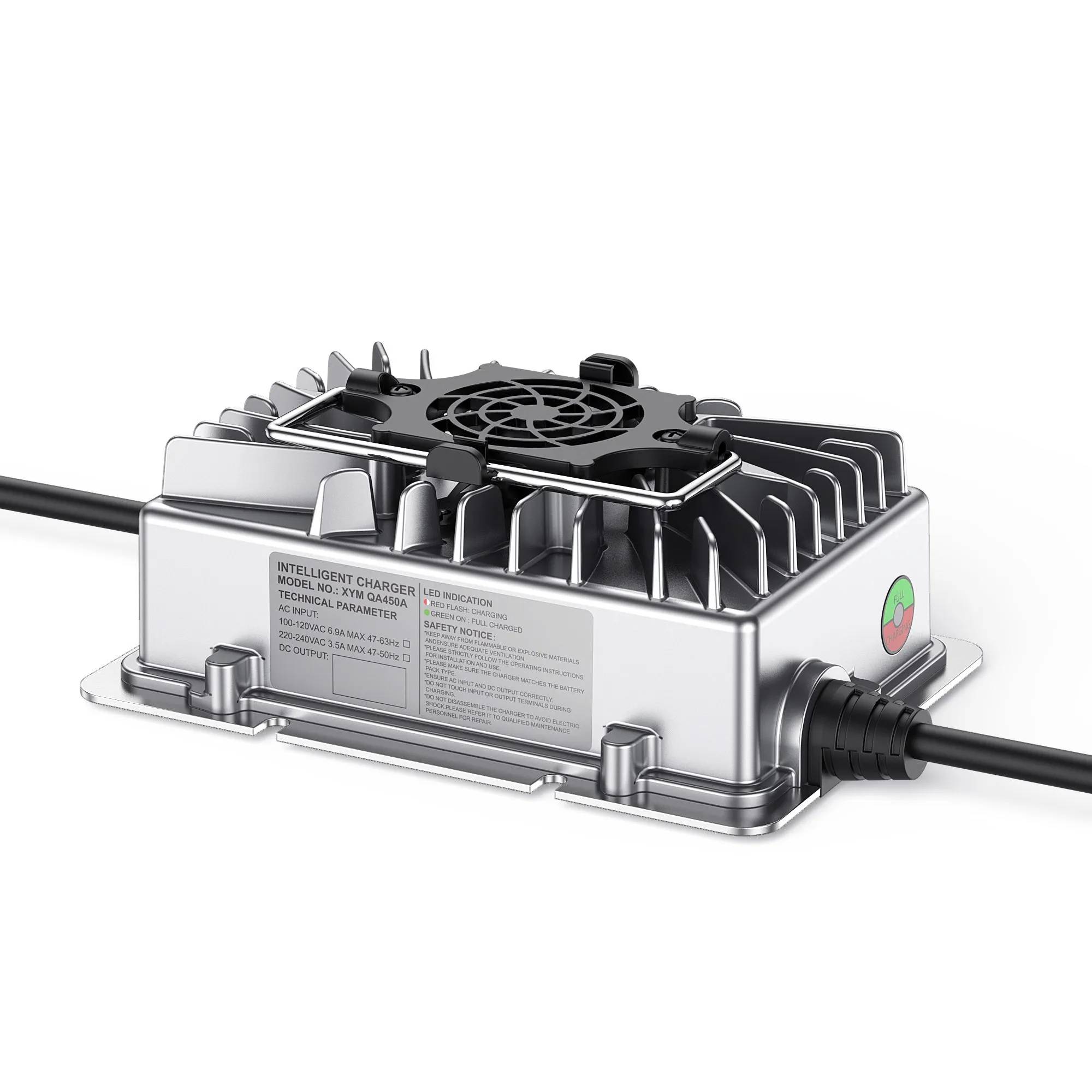
From the visible structure, this unit is a boxed electric charger with an intelligent charging label, LED indication, DC output wiring, and a rugged metal housing. The design suggests a power electronics assembly intended for fixed installation rather than a consumer tabletop charger. A finned body, central cooling fan grille, and heavy-duty cable exits indicate that thermal management and durable wiring were major design priorities.
For OEM and industrial buyers, the value is not only in charging capacity but also in packaging. A charger used on vehicles, machinery, or battery maintenance stations must withstand real site conditions. The enclosed form factor, mounting base, and strain-relief cable connections make the unit suitable for integration into panels, equipment cabinets, or service enclosures where neat cable routing and stable mounting matter.
What This Charger Is Built to Do
At a practical level, an industrial battery charger converts AC mains power into controlled DC output for charging rechargeable batteries or battery packs. The exact electrical ratings are not confirmed from the visible data, so the page should not assume a specific input voltage, battery chemistry, or charge profile. Still, the external layout clearly indicates a charger intended for managed power conversion with visible status indication and thermal control.
For buyers, that means the unit is aimed at applications where charging time, operational stability, and housing durability are more important than a simple plug-in consumer design. The visible “intelligent charger” labeling also suggests an onboard charging control function rather than a basic rectifier-only power supply, though the internal algorithm cannot be verified from the image alone.
Key Visible Features and Capabilities
Thermal Management-Focused Housing
The housing uses a finned metal body that increases surface area for heat dissipation. A central cooling fan with a protective grille is visible on the top section. This type of construction is common in compact power electronics where internal heat must be moved away from charging components during extended operation.
LED Indication for Charging Status
The front label includes LED indication, which is useful for operators who need a quick visual check of power, charging, or fault state. In industrial charging environments, visible status feedback can reduce handling errors and help maintenance staff confirm whether a unit is operating normally.
Fixed Mounting Base
The base plate and mounting feet/brackets support fixed installation. This is useful in battery maintenance rooms, equipment bays, service vehicles, or wall-mounted charging stations where the charger must remain secure during use and transport.
Rugged Cable Entry and Exit Points
Heavy-duty cable assemblies enter and exit from the sides through strain-relief connectors or cable glands. That detail matters in sealed or semi-sealed electronics because repeated movement, vibration, and tugging can stress the wiring if the termination is not reinforced.
Materials and Finish Options
Based on the visible appearance, the main enclosure appears to be a metallic silver housing, likely aluminum or aluminum alloy, with a brushed or satin finish. Black plastic components are visible on the top cover, fan grille, and cable interface areas. This combination is typical in industrial power products because metal helps with thermal performance while molded parts can support covers, guards, and cable sealing features.
For OEM projects, finish options may vary depending on the final specification package. Common industrial choices include natural aluminum, anodized surfaces, painted housings, or custom branding panels. However, no exact finish, coating, or material certification should be assumed unless supplied by the manufacturer.
Manufacturing and Assembly Approach
The visible enclosure suggests a power electronics assembly using die-cast or extruded aluminum heat-sink components combined with molded plastic covers and wiring hardware. Exact process details are not confirmed, but this construction style is widely used for compact chargers, LED drivers, and sealed control units because it balances rigidity, thermal path, and assembly access.
The likely build sequence includes enclosure preparation, mounting of internal electronic boards or modules, installation of cooling components, cable termination, cover fastening, and final electrical testing. For B2B buyers, the important point is that the product category is designed as an integrated unit rather than a loose board, which simplifies installation and enclosure design.
Application Scenarios
This 450W industrial charger format fits many charging and power-management environments. Typical use scenarios include workshop battery maintenance, warehouse charging stations, mobile service equipment, marine electrical systems, outdoor support equipment, and industrial vehicles. It may also be suitable for off-board charging where the charger is installed separately from the battery pack.
Because the image shows an enclosed, thermally managed unit with sealed wiring paths, it also fits applications where exposure to dust or splashing is a concern. That said, the exact IP rating is not verifiable from the image, so buyers should confirm environmental protection requirements before specifying the unit into a project.
Quality Control Considerations
Industrial battery chargers are usually evaluated across several practical checkpoints: enclosure integrity, connector security, thermal behavior, fan operation, output stability, and label legibility. For a product with visible heat-sink fins and active cooling, thermal consistency under load is especially important.
Buyers should ask for test documentation relevant to their project, such as electrical output verification, insulation testing, burn-in, and environmental sealing validation if needed. Exact test results are not provided here, so any purchasing decision should rely on the supplier’s approved specification sheet and inspection records.
Customization Guidance for OEM Buyers
If you are sourcing an OEM waterproof smart charging solution, several customization points are worth discussing early. Start with the required input source, output voltage range, charging current, battery type, and connector style. Then confirm enclosure size, cable length, mounting method, indicator language, and branding requirements.
For a charger used in an equipment cabinet or field service platform, cable orientation and strain relief are often as important as the electrical rating. If the unit will sit in a confined space, ask whether fan direction, vent placement, or heat-sink orientation can be adjusted to suit the installation layout. If the charger must match a larger product line, label design and housing color may also be standardized.
How Buyers Should Evaluate Fit
Before selecting a unit like this, buyers usually compare a few key factors: required charging power, battery compatibility, ambient operating conditions, mounting space, maintenance access, and protection level. A 450W charger class can be a good fit where moderate power is needed and the enclosure must remain compact.
Also consider serviceability. A charger with visible screws, accessible cable entry points, and a straightforward mount can be easier to integrate and replace than a hidden module buried in a sealed machine frame. If your application involves vibration or frequent transport, the cable glands, fasteners, and base design deserve close attention.
Why This Design Works in Industrial Settings
This product format combines several traits that industrial buyers usually want in one package: a compact footprint, metal heat dissipation, visible operating status, protected wiring, and fixed mounting. Those features do not guarantee a specific performance level, but they do show a design aimed at real-world service conditions rather than bench-top use.
The finned body and top fan are especially relevant for continuous duty or repeated charging cycles. Heat is one of the main factors that affects the long-term reliability of power electronics, so a housing built around cooling is often a practical choice in demanding environments.
Request OEM Details and Confirm Specifications
If you are evaluating this 450W IP65 Industrial Battery Charger for a project, the next step is to confirm the exact electrical specification, battery compatibility, enclosure protection level, and installation requirements with the supplier. That is the safest way to match the charger to your system without guessing at hidden parameters.
Send your target voltage, battery type, application environment, and mounting constraints. With those details, the supplier can confirm whether this smart charging platform is the right fit and what options are available for OEM customization, cable setup, and enclosure integration.